IV experiments
NAD+ and NADH in the IV record
A rat heart experiment and human Parkinson’s disease studies lead to very different claims. The compound’s full name matters before the results even begin.
NAD+ and NADH
An intravenous route can make a story feel direct: put the substance into the blood and the replenishment seems almost accomplished. For an inference based on a route, that is too much certainty for my taste. The studies below make the route only the beginning of the question.
NAD+ and NADH are the paired forms discussed in cellular redox biology, the chemistry of transferring electrons. The rat paper here administered NAD+. The Parkinson’s disease papers administered NADH. I cannot treat those names as interchangeable evidence for a general NAD+ infusion claim.
There is also a difference between studying a compound in a particular disease and asking whether it improves ordinary wellbeing. These experiments have specific subjects and specific measurements. Their titles deserve to travel with their conclusions.
The rat heart experiment
In rats subjected to myocardial ischemia/reperfusion injury, intravenous NAD+ reduced infarct size in a dose-dependent manner. Ischemia/reperfusion means blood supply is interrupted and then restored; infarct size measures the area of damaged heart tissue. The paper also reports reduced markers of apoptosis, or programmed cell death, and enhanced antioxidant capacity.
I respect the narrowness of the question. It gives the result somewhere definite to land: a rat injury model, an intravenous intervention and a measured change in heart damage. Carrying that result into a claim about human energy or recovery would require an additional experiment. The rat study supplies a reason to investigate that biology.
Two human NADH studies
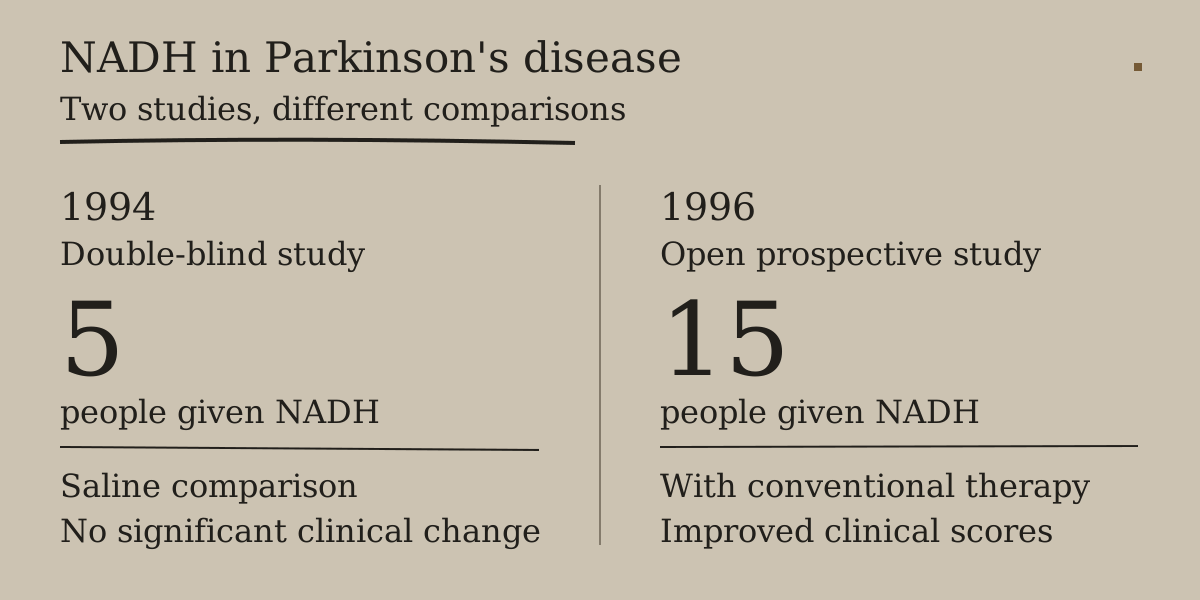
The 1994 double-blind study gave NADH to five people with Parkinson’s disease, using intravenous treatment followed by intramuscular treatment. Clinical improvement showed only a non-significant tendency, with no difference from the saline control group. Cerebrospinal-fluid biochemical markers also showed no changes.
The 1996 open prospective study involved 15 people with idiopathic Parkinson’s disease. They received intravenous NADH alongside conventional therapy. Scores on the Unified Parkinson’s Disease Rating Scale improved significantly, and plasma levodopa bioavailability increased. That last finding is unusually useful: the paper itself gives a possible contribution from the handling of an existing therapy.
I give the comparison with saline more weight when asking about an effect attributable to NADH. The open study remains interesting, especially its levodopa measurement, but its design and concurrent therapy leave a different interpretive problem. The larger participant count alone cannot settle it.
Infusion safety
These papers do not settle the safety of a general NAD+ IV programme. The heart experiment was in rats; the controlled human study concerned NADH in Parkinson’s disease, as did the open study alongside conventional therapy. Neither a biological rationale nor a favourable result in another setting gives me a usable account of infusion reactions in a broader population.
I would put tolerability, the actual preparation and a meaningful clinical outcome in the same future trial. That is a wish for evidence, not an infusion plan. This site provides no dose or administration instructions.
The cell-culture experiment adds another wrinkle to the direct-delivery picture. See what happened outside the cell, where the substance supplied to the dish was processed before uptake.